Beyond Arrakis: The Depths and Layers of the Dune Universe
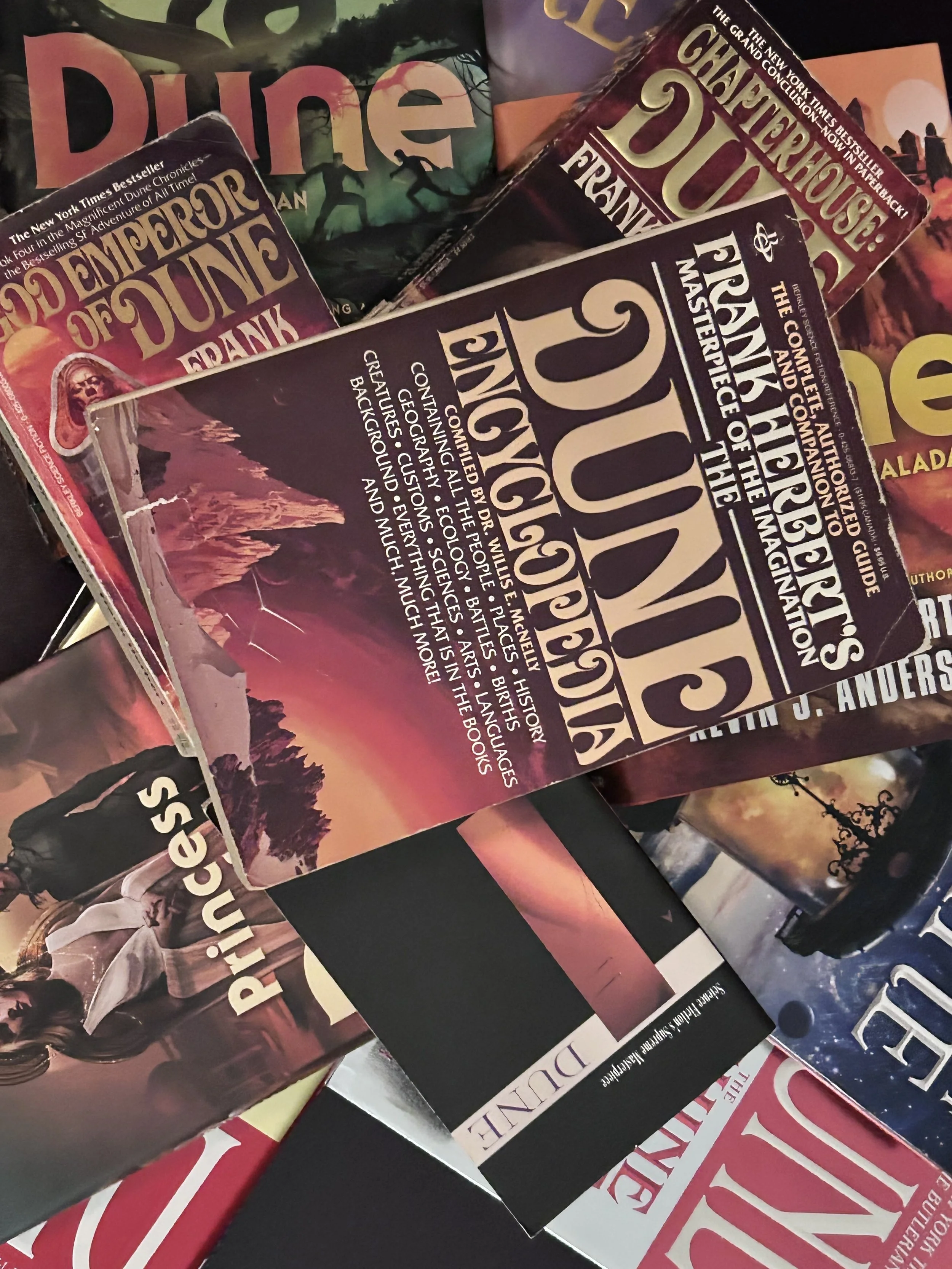
In my last post, I basically revealed how I’ve been neck deep in the Dune Universe since age 12. If someone asked me what aspects of the stories captured in the numerous books stand out most, I’d be hard-pressed to choose just one.
There are so many concepts and reflections of societies in the novels that treated with depth and complexity – politics, philosophy, religion, the strengths and weaknesses of relationships, and the weight of history and expectations. All of these things may be best captured in the fourth book of the original series – God Emperor of Dune. Without revealing too much, it’s in that novel that we see the culmination of what Paul Atreides started through his son Leto II. (No shade to James McAvoy’s portrayal in the SciFi Channel’s miniseries, but I really hope to get introduced to some version of adult Leto II in Denis Villeneuve’s Dune: Part Three film.) Paul’s son is faced with plans, machinations and treachery that he approaches with a disturbing fatalism.
I’m also a big fan of the prequels written by Brian Herbert and Kevin J. Anderson. They drew on the extensive notes and research of Frank Herbert to add historical depth and texture to the Dune Universe. We see the struggle against machines during the Butlerian Jihad. Several books not only illustrate the generations-long, deadly animosity between Atreides and Harkonnen, but show how, where and why the break occurred. And, as partially shown in the HBO series, Dune: Prophecy, Herbert and Anderson provide the underlying history of the Bene Gesserit, Guild Navigators, and Mentats in three novels – The Schools of Dune Trilogy. Most disturbing is the survival of feudalism through society’s collapse and its emergence on the other side of the rebellion against thinking machines.
Is it any wonder that something so extensive served as inspiration for Star Wars? Herbert left a rich legacy of commentary and insight into how our existences are lived. The other writers I think of with this type of impact are Octavia Butler and Ray Bradbury.
What do you like most about Dune? Let me know your thoughts.